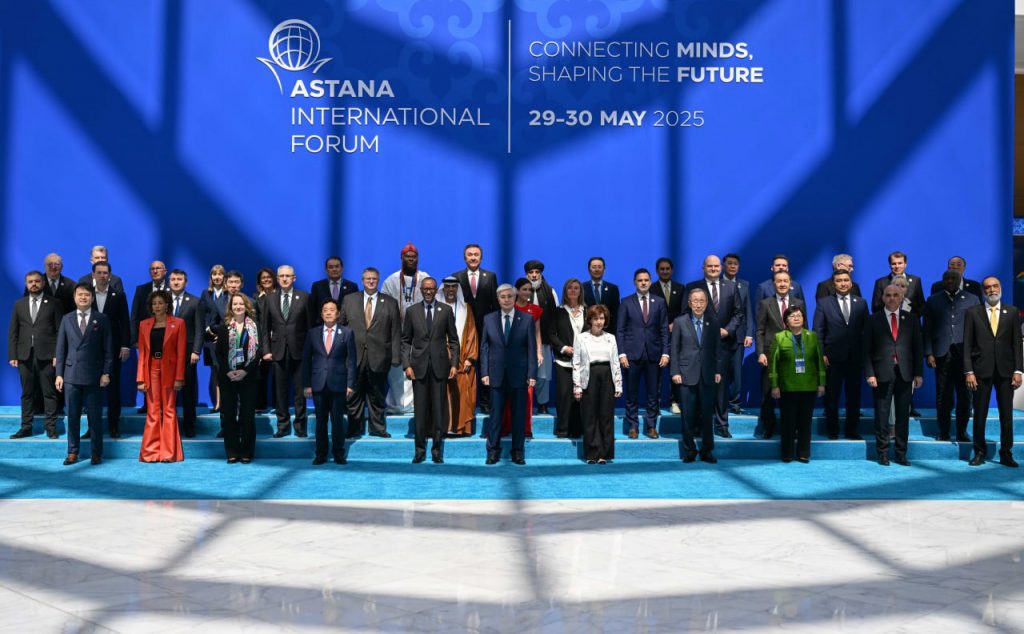
On May 29–30, 2025, Astana hosted the annual Astana International Forum (AIF), Kazakhstan’s leading platform for discussing global issues and promoting dialogue from the perspective of Central Asia and Kazakhstan. Under the theme “Connecting Minds, Shaping the Future”, the forum gathered participants from all over the world, including high-level guests such as the President of Rwanda Paul Kagame, President of North Macedonia Gordana Siljanovska-Davkova, Secretary General of the Council of Europe Alain Berset, former UN Secretary-General Ban Ki-moon and many others [AIF, 2025].
Over the two days, the forum—centered on three key themes: Foreign Policy & International Security, Energy & Climate Change, and Economy & Finance—highlighted Kazakhstan’s foreign policy priorities, fostering enhanced comprehension of the country’s strategic objectives and international positioning.
The opening speech by President Kassym-Jomart Tokayev re-emphasized Kazakhstan’s stance on international affairs [Akorda, 2025]. In particular, the president continued to advocate Kazakhstan’s aspirations to be recognized as a middle power state. In virtue of the nation’s proactive diplomatic stance and economic growth, since the early 2024, President Tokayev has been positioning Kazakhstan as a middle power by underlining its role not just as a participant but as a responsible manager in global affairs [e.g., Euronews, 2024; Gov.kz, 2024; Ana tili, 2025]. The president’s opening speech, alongside the forum discussions and side events, was also concentrated on the role of middle powers in facilitating global affairs.
While strongly adherent to the UN Charter, the president raised the issue of the necessity for structural reforms of the UN system and notably the Security Council to ensure equal representation of all regions of the globe. He believes that the world is now entering a new phase and shaping a new architecture of international relations. Therefore, more reforms and actions are needed to boost genuine engagement of all stakeholders. President Tokayev also stressed that “the threats to global security are not only geopolitical” and that a new phase of the arms race is evolving. The fragmenting global order caused the resurgence in military competition among major powers, which, besides nuclear supremacy, is driven by the technological advancements in AI technologies. Only during the last year, 52 states were experiencing armed conflict, whose economic impact of violence reached $19 trillion—nearly 13.5% of global GDP [Akorda, 2025].
The establishment of the UN Regional Center on Sustainable Development Goals for Central Asia and Afghanistan in Almaty was exemplified by the president as among the steps forward for responding regionally to these threats by providing a hub for practical solutions in the region. The 2026 Regional Ecological Summit, in partnership with the UN, is another initiative by Kazakhstan to address global issues from a Central Asian angle. The president believes that middle powers must be prepared to assume more multilateral responsibilities by expanding multilateral development engagement and possessing a vested interest in an inclusive global order.
In line with the president’s outline, the forum continued exploring regional and global affairs and Kazakhstan’s representation and interests within them. With several sessions dedicated to the geopolitical transformations of the present and to the role of middle powers, the forum enabled grasping the changing world order dynamics and Kazakhstan’s official rhetoric on the country’s foreign policy strategy as a middle power state. Sessions were also held to discuss issues of regional partnership, covering prospects for cooperation with countries in Africa, the Middle East, and the European Union.
The Middle Corridor was mentioned by the majority of speakers as among the important linchpins of connectivity. The volume of cargo transportation through the Trans-Caspian International Transport Route increased to 62% in comparison to the previous year [Akorda, 2025]. This expansion became possible because of the need to diversify existing routes in Eurasia, prompted by Russian sanctions, which also illustrate the potential for success when the interests of all parties are addressed. There, unsurprisingly, the China-Europe route saw the most significant increase in traffic. By and large, the discussions had outlined the importance of the Middle Corridor in providing connectivity and in exemplifying the untapped possibilities of the future.
Artificial intelligence, being one of the most popular topics globally, was predictably another key focus of discussions. Kazakhstan positions itself as a pioneer in digital transformation in Central Asia and targets becoming a regional IT hub in Eurasia. Accordingly, throughout the forum, Kazakhstani officials highlighted the country’s initiatives in digital adoption across all sectors of the economy. To this end, the special sessions provided a platform for more sophisticated discussions on the introduction of Alatau City and showcased Astana as a center of financial assets. By introducing foreign audiences to the advancements in digital penetration, the officials also called for collaboration to harness the potential of the nation’s digital infrastructure and human capital.
The future of sustainable development was also among the priority discussions of the forum. On that, experts addressed energy security, climate and green transition challenges, economic resilience, and carbon markets in dedicated sessions.
Overall, the forum allowed immersion in Kazakhstan’s visions of global affairs and its aspirations. The forum illustrated that, thanks to the proactive and foresight initiatives during the last decades, the country has more room for confident and strong calls for regional and global involvement. Being the largest and the most prosperous economy in the region, Kazakhstan has been playing an active role in regional developments. The ongoing geopolitical shifts in Eurasia have enabled Kazakhstan to redefine its diplomatic pursuits and to reinforce its international standing. The country positions itself as a crucial link in connecting Europe with Asia and in becoming a reliable and responsive regional actor. The forum attempted to disseminate Kazakhstan’s insights to a broader audience.
The Astana International Forum was commenced in 2008 under the name Astana Economic Forum. After holding annual forums for over a decade, in 2023 the event was renamed the Astana International Forum. This year marked the Forum’s second gathering since the cancellation of the event in 2024 due to severe floods in the country.
References:
Astana International Forum (2025). Astana International Forum. Retrieved from https://astanainternationalforum.org/. Accessed on 10.06.2025.
Akorda (2025). Statement President of the Republic of Kazakhstan Mr. Kassym-Jomart Tokayev at the Plenary session of the Astana International Forum. Retrieved from https://www.akorda.kz/en/statement-by-he-president-of-the-republic-of-kazakhstan-mr-kassym-jomart-tokayev-at-the-plenary-session-of-the-astana-international-forum-2944235. Accessed on 10.06.2025.
Ana tili (2025). President of the Republic of Kazakhstan Kassym-Jomart Tokayev: my goal is to strengthen the economy and sovereignty. Retrieved from https://anatili.kazgazeta.kz/news/63674. Accessed on 10.06.2025.
Euronews (2024). Euroviews. Middle powers have the power to save multilateralism. Retrieved from https://www.euronews.com/2024/05/28/middle-powers-have-the-power-to-save-multilateralism. Accessed on 10.06.2025.
Gov.kz (2024). The Head of State delivered a lecture on “Kazakhstan and the role of the Middle Powers: promoting security, stability and sustainable development”. Retrieved from https://www.gov.kz/memleket/entities/mfa-singapore/press/news/details/782861?lang=en. Accessed on 10.06.2025.
Note: The views expressed in this blog are the author’s own and do not necessarily reflect the Institute’s editorial policy.