
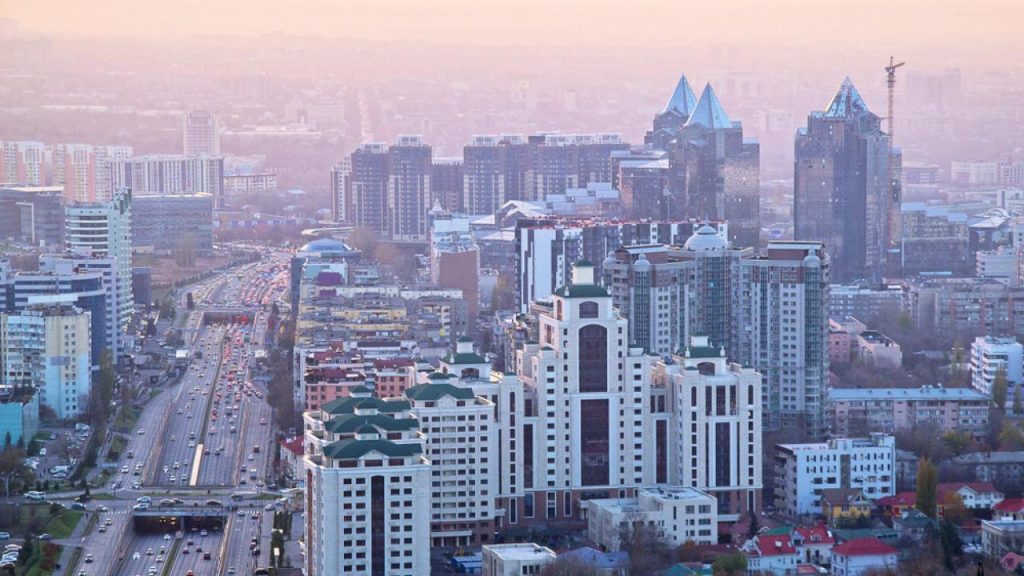
According to the most recent statistics, Kazakhstan has experienced a notable surge in urbanization, with the urban population increasing from 57.1% to 63.1% over the past decade. This growth is largely driven by internal migration from rural areas to regional centers and major cities such as Almaty and Astana (Dknews.kz, 2025). The country is approaching an important milestone of 67% at which two-thirds of the country’s population will be urban residents. This trend is viewed positively as it sets one of the pre-conditions for economic development stemming from spatial concentration of labor and capital. At the same time, the government also sees it as a challenge requiring consequent infrastructural developments.
The urbanization trend reflects deeper structural changes in Kazakhstan’s settlement patterns and economic geography. What may appear to be a simple increase in the urban population actually signifies a profound spatial reorganization of the country’s urban system and settlement structure. Firstly, urban growth in Kazakhstan has been highly uneven across cities. In particular, it has been heavily concentrated in the largest urban centers, especially those with populations exceeding 500,000. For example, in 1989, only 10% of the country’s population lived in cities with more than 500,000 residents. By 2024, this share had nearly tripled, reaching 29.3%. This trend is especially evident in cities with populations over one million (Bureau of National Statistics, 2025). As of 2024, Kazakhstan had three such cities, whereas in 1989, according to the last Soviet census, only Almaty had a population exceeding one million (Soviet census, 1989).
Table 1. Percentage of Large, Medium and Small Urban Settlements from Total Population in Kazakhstan between 1989-2024.
| 1989 | 1999 | 2009 | 2021 | 2024 | |
| Large cities (over 500,000) | 10.7 | 11.3 | 19.2 | 28.9 | 29.3 |
| Medium sized cities (250,000-500,000) | 13.7 | 14.9 | 13.1 | 13.0 | 14.2 |
| Smaller cities (under 250,000) | 23.8 | 23.8 | 24.3 | 19.2 | 17.5 |
Source: Bureau of National Statistics of Kazakhstan.
Interestingly, medium-sized cities with populations between 250,000 and 500,000 have grown at nearly the same pace as the overall population, maintaining a stable demographic share of around 13–14% throughout the period from 1989 to 2024. Despite the general trend of urbanization, the share of smaller cities, those with populations under 250,000, has declined significantly since 1989 (Bureau of National Statistics, 2025). This suggests that population growth in these smaller cities has generally lagged behind the national average. As a result, urban growth in Kazakhstan has been heavily concentrated in large cities, while being far less pronounced in smaller ones, further steepening the country’s urban hierarchy.
Compared to other Central Asian countries, Kazakhstan’s urbanization rate has been significantly higher, though still lower than in most other parts of the Soviet Union. According to the final Soviet census of 1989, nearly two-thirds of the population (65.7%) across the USSR lived in urban areas, whereas in Kazakhstan this figure stood at 56.3%. Although Kazakhstan lagged behind more urbanized republics such as Russia, Ukraine, and Belarus, where 60–70% of the population lived in cities by the end of the Soviet era, it had a considerably higher share of urban residents than its Central Asian neighbors. For example, Turkmenistan’s urban population accounted for 45%, followed by Uzbekistan at just 40.9%, while Kyrgyzstan and Tajikistan had urbanization rates below 40%, according to the last Soviet census conducted in 1989 (Soviet census, 1989).
Table 2. Urbanization in Central Asian Countries in 1989 and 2024.
| Kazakhstan | Uzbekistan | Tajikistan | Kyrgyzstan | Turkmenistan | |
| Urbanization in 2024 (%) | 63.0 | 50.7 | 28.5 | 38.2 | 46.2 |
| Urbanization in 1989 (%) | 56.3 | 40.9 | 32.5 | 38.2 | 45.0 |
Source: Bureau of National Statistics of Kazakhstan, Statistics Agency of Uzbekistan, Worldometers.info.
Since gaining independence, the differences in urbanization rates among the Central Asian countries have persisted. Kazakhstan has maintained its leading position, with the urban population now exceeding 60% (Bureau of National Statistics of Kazakhstan, 2025). Uzbekistan has only recently crossed the 50% threshold, while Turkmenistan’s urbanization rate remains below 50%. Urbanization levels remain particularly low in Kyrgyzstan, at 38.2%, and in Tajikistan, where not only has urbanization progressed slowly since the collapse of the Soviet Union, but the rural population has also grown at a faster rate than the urban population. As a result, only 28.5% of Tajikistan’s population now lives in cities, compared to 32.5% in the late Soviet period (Soviet census, 1989; Statisticstimes.com, 2025).
Undoubtedly, a myriad of factors shape the spatial demographics and the distribution of population between urban and rural areas, factors that vary significantly across the five Central Asian states. These include differences in natural population growth rates, migration patterns, and regional disparities in economic development. In many respects, the five Central Asian countries differ from one another more than one might expect, given their geographic proximity and the tendency to view them as a single region. However, the current urbanization and spatial demographic trends in Kazakhstan and other Central Asian countries have, to a significant extent, been shaped by processes that took place during the Soviet period. The stage of development at which these countries gained independence, and the inertia inherited from that era, continues to play a decisive role in shaping spatial demographics, including the urban–rural distribution of the population. Moreover, many Central Asian countries have not undertaken radical transformations or reforms capable of overcoming the legacy of the communist period and establishing new developmental trajectories.
The most fundamental baseline that has to a great extent, set the post-Soviet urbanization and spatial demographic configuration can be interpreted within the framework of the so-called Three-Sector Theory of economic development (Fisher, 1935; Clark, 1940; Fourastié, 1949). The three-sector theory divides economic development into three broad sectors: primary sector – Agriculture, mining, raw materials; secondary sector – manufacturing, construction, industry; tertiary sector – services: education, healthcare, finance, etc. The theory views economic development as shifts of labor from agriculture to industry and then to services. It helps explain the growth of cities and the spatial distribution of labor (population) by showing how economic development drives structural shifts in employment, which in turn reshape settlement patterns and urbanization.
The Three-Sector Theory views the rise of cities from rural communities largely as a consequence of industrial development, particularly the transition from the primary sector (agriculture) to the secondary sector (industry). In Kazakhstan, this process began in the late 19th and early 20th centuries, during the colonial expansion of the Russian Empire into Central Asia. However, the bulk of industrialization in Kazakhstan, as in the rest of Central Asia, took place during the Soviet period, through several distinct waves. These waves directly contributed to the establishment and expansion of many cities as industrial hubs, particularly during the early Soviet era. For example, the period 1926–1939 witnessed rapid industrialization in Kazakhstan, with the urbanization rate rising from under 9% to nearly 30%, though at the cost of significant human suffering. Subsequent industrialization campaigns, accompanied by the resettlement of non-indigenous populations into urban areas, further increased the urban share to 43.7% by 1959, 50.3% by 1970, 53.5% by 1979, and 56.3% by 1989 (Soviet census, 1926, 1959, 1970, 1979, 1989). These state-led efforts laid the foundation for many cities that would later form the core of post-Soviet Kazakhstan’s urban structure, especially in the northern and eastern regions of the country e.g., Karaganda, Temirtau, Pavlodar, and Ust-Kamenogorsk.
These processes were replicated across the rest of Central Asia, but to a lesser extent. Kazakhstan, as an inner periphery, was geographically closer to the Soviet center, more integrated into the broader Soviet system, and structurally distinct from the more “remote” peripheral republics of Central Asia. This stands in contrast to the other republics, which were treated more as distant outposts relative to Moscow (Chinn and Kaiser, 2019). Moreover, Kazakhstan’s abundance of natural resources, including coal, oil, gas, uranium, and various metals, was crucial for the development of heavy industry, which the Soviet leadership prioritized. Another key factor was Kazakhstan’s lower dependence on agriculture, which stemmed from its geography. Compared to republics like Uzbekistan or Tajikistan, Kazakhstan had relatively limited potential for traditional irrigated agriculture, making it more amenable to large-scale industrial development. As a result, despite having more or less similar initial urbanization rates at the beginning of the 20th century, the urbanization process progressed much more slowly in the rest of Central Asia compared to Kazakhstan. For instance, Uzbekistan’s urbanization rate was 20.9% in 1926 and is believed to have reached only 33% by 1970. In Tajikistan, the process was even slower, with the urban population reaching 22–24% by 1959, 35% by 1979, and 32.5% by 1989 (Soviet census, 1926, 1959, 1970, 1979, 1989).
The Three-Sector Theory predicts that countries begin transitioning from the industrial phase to a post-industrial economy when they reach a stage of mature industrialization and higher levels of income and productivity. This stage, however, is quite abstract and difficult to pinpoint precisely in practice. Western economies, for example, are believed to have begun shifting toward services in the mid-20th century. In the Soviet Union, this transition occurred later and at different times across its republics. Nevertheless, industrialization remained the dominant economic paradigm up until the very end of the USSR, which gave the Soviet economy somewhat unnatural characteristics by the time of its collapse. As such, the dissolution of the Soviet Union marked a clear dividing line, after which the rapid transition to post-industrial economies became more evident. Today, all five Central Asian economies are experiencing a growing service sector in large cities, measured by the increasing share of labor employed in services, though the pace of change varies across countries. The share of labor in agriculture is declining throughout the region, also at different rates, while the dynamics of employment in the industrial sector are more volatile and less clearly defined. As of 2025, Kazakhstan has the highest share of labor in the service sector, at 66%, followed by Uzbekistan with 58.2%, Kyrgyzstan with 51%, Turkmenistan with 44%, and Tajikistan with 37%. The share of labor employed in agriculture is lowest in Kazakhstan, at 12.1%, and highest in Tajikistan, at 42.7% (World Bank data, 2025).
In conclusion, cities in Central Asia are not merely physical settlements, but are reflections of each country’s broader economic development trajectory. The urban landscapes observed today, especially in Kazakhstan, are deeply rooted in patterns established during the Soviet period, when industrialization, resource allocation, and centralized planning shaped the spatial and economic structure of the region. The differences in urbanization levels across the Central Asian states highlight how these Soviet-era legacies continue to influence present-day development. Understanding cities as outcomes of historical economic strategies, rather than isolated phenomena, is essential for interpreting current demographic trends and for planning future urban and regional development in the region.
References:
Bureau of National Statistics, Agency for Strategic planning and reforms of the Republic of Kazakhstan (2025). Demographic Statistics. Retrieved form https://stat.gov.kz/ru/industries/social-statistics/demography/. Accessed on 22.06.2025.
Chinn, Jeff and Kaiser, Robert (2019). Russians as the new minority: Ethnicity and nationalism in the Soviet successor states (Rev. ed.). Abingdon, UK: Routledge. Retrieved form https://doi.org/10.4324/9780429305245. Accessed on 21.06.2025.
Clark, Colin (1940). The Conditions of Economic Progress. London: Macmillan.
Dknews.kz (2025). Urbanization in Kazakhstan: How cities are changing the face of the country. Retrieved from https://dknews.kz/ru/v-strane/361309-urbanizaciya-v-kazahstane-kak-goroda-menyayut-lico. Accessed on 22.06.2025.
Fisher, Allen, George (1935). The Clash of Progress and Security. London: Macmillan.
Fourastié, Jean (1949). The great hope of the 20th century: Technical progress, economic progress, social progress. Paris: Presses Universitaires de France.
Statisticstimes.com (2024). Countries by urban population. Retrieved form https://statisticstimes.com/demographics/countries-by-urban-population.php?utm_source. Accessed on 19.06.2025.
USSR Central Statistical Administration (1928). All-Union population census of 1926. Moscow: Gosstatizdat.
USSR Central Statistical Administration (1960). All-Union population census of 1959. Moscow: Gosstatizdat.
USSR Central Statistical Administration (1972). All-Union population census of 1970. Moscow: Finansy i Statistika.
USSR Central Statistical Administration (1980). All-Union population census of 1979. Moscow: Finansy i Statistika.
USSR State Committee for Statistics (1990). All Union population census of January 12–19, 1989.
World Bank data (2025). World Bank Open Data. Retrieved form https://data.worldbank.org/. Accessed on 22.06.2025.
Worldometers.info (2024). Turkmenistan population. Retrieved form https://www.worldometers.info/world-population/turkmenistan-population/. Accessed on 20.06.2025.
Note: The views expressed in this blog are the author’s own and do not necessarily reflect the Institute’s editorial policy.