
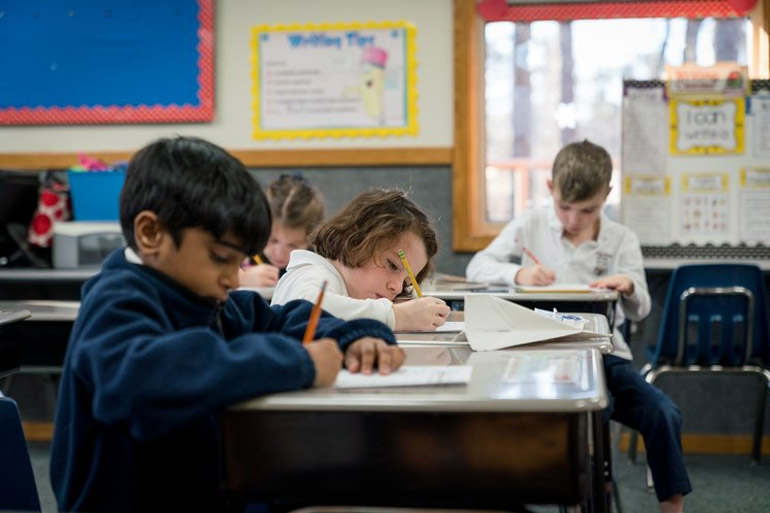
The role of education in the history of humankind cannot be overstated. Arguably, education allowed humans to continuously build a knowledge base about the world and use it to advance our understanding of the environment and each other, fueling the progress of sciences. For instance, the invention of the printing press and the subsequent increase in literacy rates were one of the main factors behind Europe’s revolutionary societal and economic transformations of the Renaissance era, which led the continent into the age of prosperity, and economic and political dominance. Therefore, for all modern states, the educational system is one of the cornerstones of economic, social, and bureaucratic systems. A properly designed and maintained educational system can provide the country with valuable specialists for the labor market and economy, strengthen its societal ties, which results in higher levels of trust between people, and even attract foreign talent and investments to a country.
However, not all countries can afford a complex, high-quality, multifaceted educational system that satisfies all of the states’ and people’s needs, especially when it comes to tertiary education. The development of such a system requires immense experience to build upon and a constant flow of financial and intellectual resources for support and expansion. A high-quality educational system is a product of massive investments in infrastructure, including land, buildings, and equipment, and even greater investment in human capital, namely, academic staff of universities and teaching staff of schools, whose expertise will define the skills and knowledge of their students – the country’s future. Moreover, those investments are to be spread equally throughout the country, otherwise, the knowledge centers will be over-concentrated in certain, usually highly urbanized regions. To achieve that, OECD countries, for instance, invested an average of 5% of their GDP in education in 2021 (World Bank, n.d.) which amounted to a total of 77.5 billion USD approximately. Many countries, especially developing ones, cannot bear such costs, and their students tend to look for opportunities abroad. For instance, there are 1.33 million Indian students who studied abroad in 2024 (Nair, 2024), and there were more than 1.02 million Chinese students in the universities of other countries in 2021 (Lu and Huiyao, 2024). While such numbers are great for illustrative purposes, many other much smaller developing nations send many of their students to global universities every year.
Such a pattern might not even be a part of a state policy – many governments don’t want their youth to leave the country “en masse”, considering that a sizable portion of the students from developing countries tend to stay in their host countries. For instance, about 41% of international graduates remain in the US for prolonged periods, and the retention rate is the highest for the most educated specialists – 3 out of 4 PhD graduates and about 50% of Master’s program graduates remain in the US (Economic Innovation Group, 2024). Many countries see this as a clear example of brain drain and thus take what they see as a necessary action to prevent further damage to their economic, scientific, and professional resources. However, in many cases, the population is the main driver behind the constant stream of students flowing toward foreign universities. Parents who wish to increase their children’s probability of career success through quality education and can afford a higher cost, look for the best universities in their respective fields and often end up picking options abroad. Youngsters, who strive for separation, freedom, and socialization also tend to search for options abroad. Despite the best efforts of governments, people will find opportunities to fulfill their wishes. One prominent example of this is Turkmenistan, which was a closed state that limited its citizens’ movements for decades, however, people still find ways to attain a better education in foreign countries. Even in 2022 when the government temporarily barred Turkmen students from leaving the country, their families still came up with strategies for bypassing the restrictions, such as bribing individual migration officials to let students board the planes (Radio Liberty, 2022).
This struggle between what governments believed to be the best for their nations or regimes and people’s wishes has been around for decades. Voting with one’s feet has been the most popular protest strategy in human societies long before statehood in its current form was established as a global norm. However, relatively recently, the debate has become more sophisticated. According to Kwak and Chankseliani (2024), international student mobility can have long-term positive effects on the economies of low- and middle-income countries of those students. Students exposed to foreign norms, cultures, and practices can develop a drastically new perspective toward the situation in their home country and become one of the vehicles of future positive changes through their actions, by inspiring and helping others, or serving intermediaries between societies. Moreover, even their skills alone, if brought back to their country of origin, can provide a foundation for faster economic growth, which leads to an overall increase in wealth and a more equitable distribution. Naturally, it cannot be expected that all students who study abroad will become such beacons of change; furthermore, as discussed earlier, many students would prefer to live and apply their new valuable skills in the country where they studied. Even those who come back may not find a suitable place in their home labor market due to the differences in economic complexity and skill requirements. Yet, even if a relatively small percentage of graduates return to their home countries, equipped with valuable knowledge and skills and motivated to make a positive impact – they can leave a mark. Thus, while the issues regarding the brain drain are still relevant, it seems that for many developing countries it is better in the long run to send their youth to study abroad, while doing what they can to motivate the future graduates to return home, bringing economic, social and institutional value with them.
On the other hand, there is a constant debate on the opposite side of international education in the host countries. Those countries tend to be some of the most economically developed nations in the world with a long history of investment in science and academia in general. Numerous lists of the highest quality universities always include well-known examples of universities from the US and the UK, such as Oxford, MIT, Harvard, etc. (Times Higher Education, 2024). Those universities capture the imaginations of millions, receive dozens of thousands of applications per year (Goncalves and Josephy, 2024), and have almost unlimited freedom of picking the best of the best while charging astronomical fees. The countries they have been developed in also reap the benefits of this status quo by receiving talent, taxes, and exposure. For instance, according to a study by London Economics (2023), the total net financial impact of international students who started their studies in the UK in 2021/2022 is estimated to be £37.4 billion after deducting the costs, which is an enormous boost to the country’s economy.
Nonetheless, despite the benefits mentioned that are firmly entrenched in our heads, there are numerous downsides to having an educational system that attracts so much international attention. Firstly, there is the issue of financial addiction – COVID-19 demonstrated that many universities are very exposed to external shocks that can negatively affect their revenues – Australian universities lost 2.2 billion Australian dollars in 2020 alone due to the drop in revenue streams from international students (Hurley et al., 2021). This also provides other countries with leverage – if a sizable part of the international students’ community within the host country comes from one state, this state can directly influence academic and even governmental policies in the host country through financial incentives that come with its students. Secondly, an issue that has been steadily worsening for decades in most Western countries, despite the best efforts of dozens of political leaders coming from across the political spectrum – the housing crisis (Lopez, 2024). While the nature of the real estate crisis lies outside this article, its consequences affect the favorability of higher international education in host countries. The constant and ever-expanding flow of typically wealthy foreign students who come to developed countries with a wish to stay disrupts an already broken rent and real-estate market even further, pricing some of the less prosperous locals out of denser urban areas.
Today it can be said that the trend is headed towards the decline of internationalization in education. According to Chankseliani and Kwak (2024), “the UK saw a 44 percent drop in study visa applications compared with 2023 following its ban on international students bringing dependents”. While less dramatic, such a trend can be found in the US as well – 31% fewer student visas were issued in 2023 compared to 2015 (ICEF Monitor). Some other major student-receiving countries such as Australia have also demonstrated the same patterns in recent years or intend to reduce the student flow shortly (Government of Canada, 2024). In all those cases, this reduction in the number of students is a choice made by the government and not a byproduct of external forces. As a result, many students either stay to study within their countries or look for different options – for instance in recent years there has been a surge in the number of international students in continental Europe, and some Asian and Gulf countries, yet it is evident that those countries do not have sufficient capacities to satisfy all of the coming demand (Jack, 2024).
In any case, the age of deglobalization is imminent in education. This might result in numerous global drawbacks that will be felt in both developed and developing countries. Each side is now to adapt to the changing status quo, which will require careful recalibration of the existing processes and systemic shifts in the countries’ policies. Time will tell who will come out of this situation in better shape, but the inevitable fact is that the international education market will not be the same soon.
Kazakhstan has not yet experienced a mass exodus of its students from foreign universities. Still, it is looking forward to increasing the number of foreign students in its local universities as an alternative center for the education of students, especially from some Asian countries. These new trends can raise the prestige of Kazakhstani education. Still, they also carry certain obligations – it is necessary to improve the quality of education, diversify educational programs, increase the number of disciplines in English, prepare campus infrastructure, etc. The Kazakhstani Higher Education system ought to search for new prospects today, and a preliminary analysis of the situation should have started yesterday.
References:
Chankseliani, Maia and Kwak, Joonghyun (2024). Clamping down on international HE will damage global development. Retrieved from https://www.timeshighereducation.com/blog/clamping-down-international-he-will-damage-global-development. Accessed on 12.11.2024.
Economic Innovation Group (2024). Most international graduates of American universities ultimately leave the US. Retrieved from https://eig.org/immigrant-retention-estimates. Accessed on 16.11.2024.
Goncalves, Elyse and Josephy, Matan (2024). Harvard accepts 3.59% of applicants to the class of 2028. Retrieved from https://www.thecrimson.com/article/2024/3/29/harvard-class-of-2028-regular-decision/. Accessed on 15.11.2024.
Government of Canada (2024). Canada to stabilize growth and decrease the number of new international student permits issued to approximately 360,000 for 2024. Retrieved from https://www.canada.ca/en/immigration-refugees-citizenship/news/2024/01/canada-to-stabilize-growth-and-decrease-number-of-new-international-student-permits-issued-to-approximately-360000-for-2024.html. Accessed on 15.11.2024.
Hurley, Peter, Hildebrandt, Melinda, and Hoang, Sam (2021). Universities lost 6% of their revenue in 2020 — and the next 2 years are looking worse. Retrieved from https://theconversation.com/universities-lost-6-of-their-revenue-in-2020-and-the-next-2-years-are-looking-worse-166749. Accessed on 15.11.2024.
ICEF Monitor (2024). US study visa refusals reached record levels in 2023. Retrieved from https://monitor.icef.com/2024/04/us-study-visa-refusals-reached-record-levels-in-2023/. Accessed on 13.11.2024.
Jack, Patrick (2024). Visa curbs drive ‘historic change’ in global student flows. Retrieved from https://www.timeshighereducation.com/news/visa-curbs-drive-historic-change-global-student-flows. Accessed on 20.11.2024.
Kwak, Joonghyun and Chankseliani, Maia (2024). International student mobility and poverty reduction: A cross-national analysis of low and middle-income countries. International Journal of Educational Research 128: 1-13.
London Economics (2023). The benefits and costs of international education students to the UK economy. Retrieved from https://www.hepi.ac.uk/wp-content/uploads/2023/05/Summary-Report-Benefits-and-costs-of-international-students.pdf. Accessed on 13.11.2024.
Lopez, Denisse (2024). A global housing crisis is suffocating the middle class. Retrieved from https://english.elpais.com/economy-and-business/2024-09-29/a-global-housing-crisis-is-suffocating-the-middle-class.html. Accessed on 15.11.2024.
Lu, Miao and Huiyao, Wang (2024). China is still the leading source of foreign students. Retrieved from https://www.chinadaily.com.cn/a/202403/16/WS65f4e78ba31082fc043bcf71.html. Accessed on 15.11.2024.
Nair, Abhiskek (2024). Over 1.3 million Indian students studying abroad in 2024. Retrieved from https://thepienews.com/over-1-3-million-indian-students-studying-abroad-in-2024/. Accessed on 16.11.2024.
Radio Liberty (2024). Turkmenistan bars students from leaving the country ahead of the census. Retrieved from https://www.rferl.org/a/turkmenistan-students-banned-leaving-population-decline-/32127844.html. Accessed on 15.11.2024.
Times Higher Education (2024). World University Rankings 2024. Retrieved from https://www.timeshighereducation.com/world-university-rankings/2024/world-ranking. Accessed on 14.11.2024.
World Bank (n.d.). Government expenditure on education, total (% of GDP) – OECD members [Data set]. Retrieved from https://data.worldbank.org/indicator/SE.XPD.TOTL.GD.ZS?locations=OE. Accessed on 13.11.2024.
Note: The views expressed in this blog are the author’s own and do not necessarily reflect the Institute’s editorial policy.