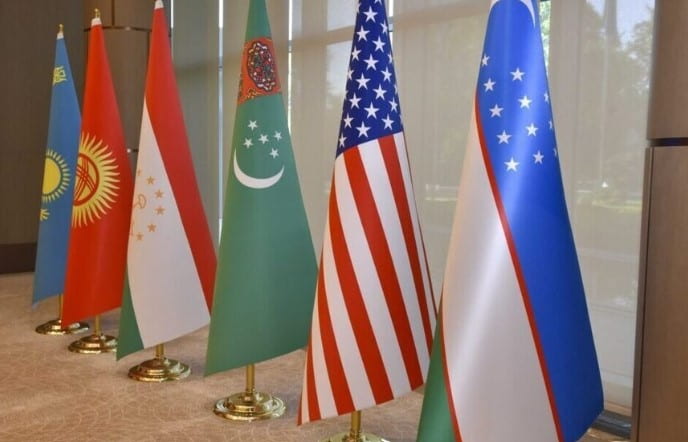
Kazakhstan’s longstanding multi-vector policy is a foreign policy mechanism aimed at balancing diplomatic, economic, and security ties among Russia, China, the West, and regional and inter-governmental institutions. The security landscape of Central Asia is shaped by a complex interplay of traditional and non-traditional security concerns, spanning internal and external, military and non-military dimensions. While such a typology may seem straightforward, the region’s security architecture is distinguished by the interwoven nature of these concerns, where localized and transnational challenges interact in mutually reinforcing ways. Many of them transcend national boundaries, linking the regional security complex to broader international frameworks. As Lemon (2018) notes, such interconnectedness calls for a more coordinated and collective response among Central Asian states, encouraging them to align strategies and pool resources.
Since the early 1990s, Central Asia has undergone a significant geopolitical shift. The dissolution of the Soviet Union catalyzed the emergence of independent republics that quickly sought to engage with major global powers and establish sovereign foreign policies (Sullivan, 2019). Over the past three decades, Central Asia has become a key arena of Eurasian geopolitics. Developments such as China’s Belt and Road Initiative (2013), the US withdrawal from Afghanistan (2021), and the Russia-Ukraine war (2022) have heightened the region’s strategic relevance and redefined security priorities.
Amid these changes, Kazakhstan has emerged as a pivotal actor in maintaining regional stability. Its multi-vector foreign policy functions as a core strategic tool, allowing the country to sustain balanced relationships both within the region and with external powers. This approach supports Kazakhstan’s engagement in key multilateral organizations, including the Commonwealth of Independent States (CIS), Collective Security Treaty Organization (CSTO), Shanghai Cooperation Organization (SCO), Eurasian Economic Union (EAEU), and the Organization of Turkic States (OTS), through which it promotes diplomatic dialogue, economic cooperation, and joint security initiatives (Vanderhill et al., 2020).
Kazakhstan’s foreign policy is marked by deliberate pragmatism. The ability to take proactive positions while maintaining neutrality when necessary has enabled it to navigate shifting geopolitical dynamics and balance competing regional interests (Sullivan, 2019; Abbasova, 2022). Its abstention from the UN General Assembly vote on Ukraine’s territorial integrity (Yuneman 2023), and President Tokayev’s public stance against recognizing the Russian-backed territories of Donetsk People’s Republic (DPR) and Luhansk People’s Republic (LPR), illustrate a nuanced diplomatic posture that preserves both flexibility and independence (The Astana Times, 2022).
Under the current international geopolitical circumstances, it would be useful to analyze the balance and priorities of the multi-vector policy direction which Astana pursues to solidify its position. First and foremost, the Russia-Ukraine war in 2022 has reinforced the further disruption of the regional security network since both countries were members of CIS, which despite not being a security-oriented organization like CSTO allowed for deeper cooperation among regional states. Moreover, sanctions imposed on Moscow caused a spillover negative effect on Kazakhstan’s economy. In response, Astana has in fact accelerated its quest for new economic and diplomatic partners. For example, President Tokayev’s trips to China in 2023 yielded major trade and infrastructure agreements, signaling a boost in Sino-Kazakh cooperation (Dukeev, 2023). The government also looked to multilateral forums when it concluded a Free Trade Agreement with the Eurasian Economic Union and Iran in 2023 (Official Information Source of the Prime Minister of the Republic of Kazakhstan, 2023) and Singapore in 2025 (The Astana Times, 2025) while actively participating in EU-Central Asia dialogues.
As for security perspectives, Astana pursues to enhance its military cooperation with different partner countries like the US, European Union (EU), China, and Türkiye. Moreover, these efforts are not limited to these major players but also reach out to other countries; establishing military cooperation with Qatar is exemplary in this regard (Nurmaganbetova, 2024). Thus, 2022 has pushed Kazakhstan onto a path of enriching its economic, foreign policy, and security partner selections to bring a more balanced perspective on its foreign policy.
The effect of these initiatives is steadily gaining momentum with Kazakhstan’s defense budget rising up to 11.6% in 2023 compared with 2022 (roughly 1.2 trillion tenge, or $2.5 billion); the 2023 January–August period was already 6.8% higher than the previous year, as the Astana signals the need to bolster its own forces (Sakenova, 2023). Although by international standards 0.5% of the GDP budget is considered a modest figure, total spending of $5.2 billion on defense and law enforcement portrays a rather different picture (The Caspian Post, 2024).
As such, while Astana is paying more attention to strengthening its internal defense capabilities, it is not neglecting cooperation opportunities with major regional actors, including, first and foremost, Russia. For instance, during the January events of 2022, Astana invoked Article 4 of the Collective Security Treaty Organization (CSTO) on January 5, 2022; a move called in the Russia-led CSTO peacekeeping force – the first such deployment in the bloc’s 30-year history, which marked a high-stakes moment for Kazakhstan’s security alignment (Eurasianet, 2022). CSTO troops landed on Almaty on January 9, 2022 (Gosselin-Malo, 2022) and by January 13 President Tokayev announced that order had largely been restored and that foreign forces could begin withdrawing and all CSTO troops departed by January 19 (RadioLiberty, 2022; Gleason and Dunay, 2022). In early 2024 President Tokayev called the CSTO ‘a guarantor of security’ after the end of one-year Kazakh chairmanship of the CSTO (Omirgazy, 2024). Hence, at the leadership level, Kazakhstan remains a founding CSTO member and even supplies the organization’s secretary-general, Imangali Tasmagambetov (Otkjær, 2025).
In line with its multi-vector policy, Kazakhstan has also been developing its relations with the Turkic States under the umbrella of the OTS. Kazakhstan continues to strengthen its security and defense ties with Türkiye, a country that managed to increase its conventional military strength in different areas, and which unmanned aerial vehicles and armed unmanned aerial vehicles are deemed to be one of the most effective ones (Bicer, 2022). During President Tokayev’s visit to Türkiye in May 2022, the sides signed a number of agreements in economy, security, trade, and other fields in order to elevate the level of strategic partnership between Astana and Ankara. Among them one of the most significant developments is the agreement between Turkish Aerospace Industries (TUSAŞ) and Kazakhstan Engineering, allowing for the licensed production of Türkiye’s Anka unmanned aerial vehicles (UAVs) in Kazakhstan. This makes Kazakhstan the first country outside Türkiye to receive both the license and the necessary facilities to manufacture the Anka UAV. Likewise, the two countries also formalized a military intelligence cooperation agreement (Bicer, 2022).
Thus, 2022 marked a starting point for a recalibration of Kazakhstan’s multi-vector policy. From the security perspective, Astana has kept its strong ties to the CSTO alongside distancing itself from Moscow’s foreign policy agenda. Additionally, Kazakhstan has increased its military expenditure to boost domestic capabilities via, for instance, using its close ties with Ankara to strike a deal in getting a license to produce Anka UAVs in the country, which has shown its both military and civilian usage capabilities in different conditions and countries. Astana strives to re-consider the narrative of its multi-vector policy towards a more proactive approach aimed at opening new areas of diplomatic, economic, and security cooperation alternatives with different countries, including China, the EU, and Türkiye, to bring better balance to its security concept without alienating Moscow along the way.
References
Abbasova, Vusala (2022). President Tokayev Says Kazakhstan Will Not Recognize Donetsk, Lugansk as Independent States. Retrieved from https://caspiannews.com/news-detail/president-tokayev-says-kazakhstan-will-not-recognize-donetsk-lugansk-as-independent-states-2022-6-20-0/. Accessed on 28.12.2024.
Bicer, Aysu (2022). Türkiye to Produce Drone in Kazakhstan. Retrieved from https://www.aa.com.tr/en/economy/turkiye-to-produce-drone-in-kazakhstan/2584822. Accessed on 24.06.2025.
Dukeev, Berikbol (2023). Kazakhstan Cautiously Builds Ties with China. Retrieved from https://jamestown.org/program/kazakhstan-cautiously-intensifies-ties-with-china/#:~:text=fulfill%20Kazakhstan%E2%80%99s%20economic%20needs%20and,Russia%2C%20further%20underscoring%20this%20pivot. Accessed on 10.06.2025.
Eurasianet (2022). CSTO agrees to intervene in Kazakhstan unrest. Retrieved from https://eurasianet.org/csto-agrees-to-intervene-in-kazakhstan-unrest#:~:text=A%20Russia,that%20it%20has%20done%20so. Accessed on 10.06.2025.
Gleason, Gregory, and Dunay, Pal (2022). CSTO Deployment in Kazakhstan: Strategic Shift or Political Consolidation? Retrieved from https://thediplomat.com/2022/02/csto-deployment-in-kazakhstan-strategic-shift-or-political-consolidation/#:~:text=Vyacheslav%20Sutyrin%20saw%20broad,%E2%80%9D. Accessed on 10.06.2025.
Gosselin-Malo, Elisabeth (2022). Kazakhstan as the exception: CSTO’s first armed conflict intervention. Retrieved from https://aspeniaonline.it/kazakhstan-as-the-exception-cstos-first-armed-conflict-intervention/#:~:text=Cargo%20aircrafts%20are%20being%20unloaded%3B,of%20inaction%20up%20until%20now. Accessed on 10.06.2025.
Lemon, Edward (2018). Critical approaches to security in Central Asia: An introduction. Central Asian Survey, 37 (1): 1-12.
Nurmaganbetova, Zhanna (2024). Kazakhstan and Qatar to foster military cooperation. Retrieved from https://qazinform.com/news/kazakhstan-and-qatar-to-foster-military-cooperation-19d6dd. Accessed on 11.06.2025.
Official Information Source of the Prime Minister of the Republic of Kazakhstan (2023). EAEU Free Trade Agreement signed with Iran. Retrieved from https://primeminister.kz/en/news/eaeu-free-trade-agreement-signed-with-iran-26798. Accessed on 11.06.2025.
Omirgazy, Dana (2024). Tokayev Reviews Outcomes of Kazakhstan’s Chairmanship in CSTO During Astana Session. Retrieved from https://astanatimes.com/2024/11/tokayev-reviews-outcomes-of-kazakhstans-chairmanship-in-csto-during-astana-session/. Accessed on 11.06.2025.
Otkjær, Albert (2025). Kazakhstan’s Ambivalent Relationship With the CSTO. Retrieved from https://thediplomat.com/2025/04/kazakhstans-ambivalent-relationship-with-the-csto/. Accessed on 11.06.2025.
RadioLiberty (2022). Russia-Led CSTO Troops Begin Withdrawal from Kazakhstan. Retrieved from https://www.rferl.org/a/kazakhstan-csto-troops-withdrawal-russia/31652147.html. Accessed on 11.06.2025.
Sakenova, Saniya (2023). Kazakhstan Spends $1.5 Billion on Defense This Year. Retrieved from https://astanatimes.com/2023/10/kazakhstan-spends-1-5-billion-on-defense-this-year/#:~:text=Overall%2C%20Kazakhstan%20had%20planned%20to,more%20than%20in%202022. Accessed on 10.06.2025.
Sullivan, Charles (2019). End of an Era? Kazakhstan and the Fate of Multivectorism. Kazakhstan and the soviet legacy: Between continuity and rupture: 31-50.
The Astana Times (2022). Kazakhstan Announces Its Position on Referendums in DNR and LNR. Retrieved from https://astanatimes.com/2022/09/kazakhstan-announces-its-position-on-referendums-in-dnr-and-lnr/. Accessed on 11.06.2025.
The Astana Times (2025). Kazakh President Signs Free Trade Law Between EAEU and Singapore. Retrieved from https://astanatimes.com/2025/01/kazakh-president-signs-free-trade-law-between-eaeu-and-singapore/. Accessed on 11.06.2025.
The Caspian Post (2024). Kazakhstan”s Budget Spending to Increase by 7% in 2025. Retrieved from https://caspianpost.com/politics/kazakhstan-s-budget-spending-to-increase-by-7-percent-in-2025?. Accessed on 11.06.2025.
Vanderhill, Rachel, Sandra F. Joireman, and Roza Tulepbayeva (2020). “Between the bear and the dragon: multivectorism in Kazakhstan as a model strategy for secondary powers.” International affairs 96 (4): 975-993.
Yuneman, Roman (2023). Kazakhstan’s multi-vector foreign policy. Russia in Global Affairs, 21(2): 141-162.
Note: The views expressed in this blog are the author’s own and do not necessarily reflect the Institute’s editorial policy.